
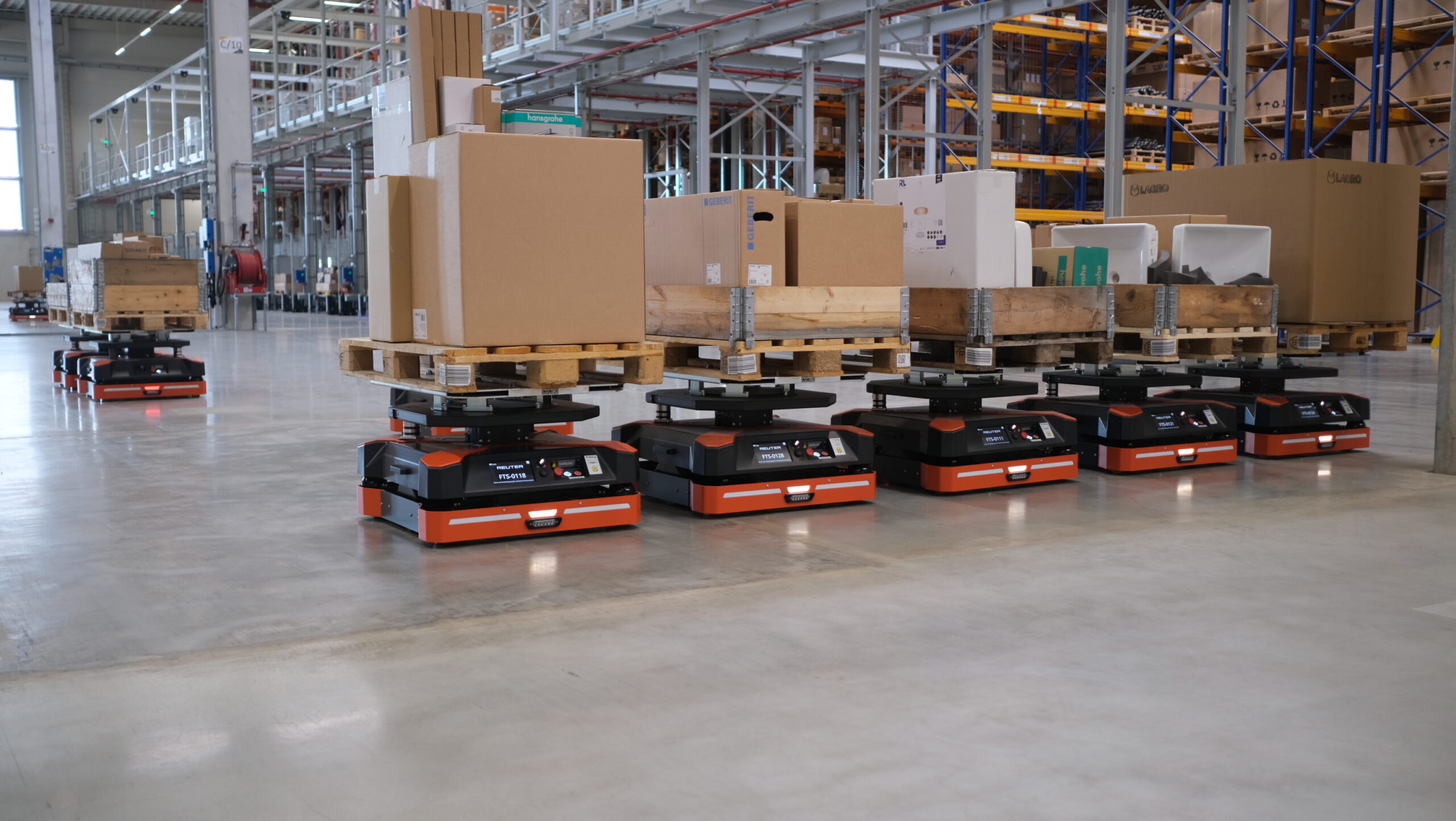
The U.S. market for warehouse automation is growing significantly. For SAFELOG, the U.S. is one of the most important growth markets worldwide. Here’s an overview of the market situation, the differences compared to Germany, and our plans in North America.
The market has reached the scaling phase
Demand for automation in the U.S. continues to grow strongly. The reasons include the ongoing shortage of skilled workers, the pressure to guarantee shorter delivery times, and the desire for more efficient, scalable logistics processes. Interest in mobile robotics and flexible automation is particularly high.
From our perspective, the pilot project phase is over. Companies are now systematically expanding their robot fleets. It has been proven that mobile robots operate safely in industrial settings, and the market trusts the technology. This means other questions now take center stage: How cost-effective is a solution? How reliable is it? How quickly can it be implemented? Pure technology demonstrations are taking a back seat.
The U.S. as a Strategic Growth Market
The U.S. market is large, invests heavily, and is open to automation. We expect it to continue growing at an above-average rate in the coming years. We benefit from this through our position in mobile robotics and through strong partnerships. Our collaboration with TGW Logistics gives us access to challenging automation projects at global corporations with complex logistics structures. Our partnership with Mercedes-Benz has significantly strengthened our visibility and credibility in North America.

TGW Logistics is s strategic partner of SAFELOG GmbH. (Source: TGW Logistics)
We also began early on to have our products certified by TÜV SÜD for the North American market. The SAFELOG S3, M4, and L2 models have already successfully passed UL 3100 certification. The robots in the GT1 and XS1 series are currently undergoing the certification process.

The SAFELOG L2lift mobile robot undergoing UL certification. (Source: SAFELOG GmbH)
Sustainable Growth, Strong Foundation
SAFELOG is pursuing a long-term growth strategy in North America. Two goals are central to this strategy: expanding existing customer relationships and strengthening our local presence. To this end, we are expanding our partner network and continuously investing in sales, service, and project capabilities. This enables us to reach our customers in the U.S. even faster and provide them with better support.
We are deliberately focusing on sustainable growth and close collaboration with strong partners. The future development of the global economy is difficult to predict. That is why we are closely examining how we can make our North American strategy crisis-proof in the long term. One possibility we have already discussed internally would be establishing our own production facility in the U.S.
Germany: High Demand, Greater Caution
Germany remains a key market for SAFELOG. However, companies here are currently investing with greater caution than in the U.S. Due to the overall economic situation, many firms are currently postponing major investments.
Nevertheless, the demand for automation remains high. A shortage of skilled workers, rising costs, and the desire for resilient supply chains continue to point toward positive market development. However, decision-making often takes longer, and investments must demonstrate their economic benefits more quickly.
Impressions from MODEX 2026 in Atlanta
In April 2026, we attended the MODEX trade show in Atlanta as visitors, and it left a very positive impression. The show demonstrated just how much momentum there currently is in the North American market. Many conversations centered on specific investments, the pursuit of higher productivity, and the cost-effective implementation of automation projects.
MODEX can only be compared to LogiMAT to a limited extent, since we are exhibitors at LogiMAT. Nevertheless, one thing stood out: MODEX focuses heavily on North and Central America, while Europe plays a secondary role for the companies there. At the same time, the trade show confirmed that many U.S. companies are highly willing to invest in the automation of their intralogistics.

A view inside an exhibition hall at Modex 2026.(Source: SAFELOG GmbH)
Similar Challenges, Different Decision-Making Processes
Customers and prospects in the U.S. and Germany face similar problems: a shortage of skilled workers, rising costs, and increasing performance requirements.
The differences lie in the decision-making process. In our experience, U.S. customers make more pragmatic decisions and focus more on measurable results. German customers often examine technical details and processes more thoroughly and take more time to compare different solutions. Both approaches have their merits, but they lead to different decision-making processes.
Robustness Rather Than an End in Itself: An Approach That Resonates in the U.S.
For us, innovation is not an end in itself. What matters is that a solution operates reliably in day-to-day operations and delivers measurable added value. This is exactly what we’re seeing in the U.S. market. Customers rarely ask how innovative a technology is. They want to know how reliably it operates in three-shift operations and when the investment will pay off. This aligns with SAFELOG’s philosophy. Our goal is to create real customer value rather than incorporating as many technical innovations or oversized solutions as possible. This customer value is evident in systems that operate stably, efficiently, and cost-effectively over the long term. Many U.S. companies view this pragmatic approach as a strength, and it contributes significantly to our success in North America.
Nevertheless, innovation is important to us. Especially when it comes to software, we are constantly refining our systems: intelligent fleet management, optimization of material flow, deeper system integration, and more efficient order processing. For us, innovation is not just a marketing promise. It ensures that our systems remain robust and scalable over the long term.